


14 Jul Your financial planner as your investment coach Part 7
Image by eko pramono from Pixabay
Doing the boring stuff
In the final article of this series, we look at an additional area where a financial planner adds real value. The undertaking of some of the menial, yet highly valuable, administrative functions. One such example being tax planning in a controlled manner, avoiding as little time out of the market as possible. We all hate paperwork, so let someone else take care of it!
Whilst the adoption of a sensible, evidence-based philosophy and the structuring of a robust ‘portfolio for all seasons’ are the primary steps in the investment process, the true value of the planner, goes way beyond this.
Vanguard is one of the world’s largest asset managers, managing more than $10 trillion of investor assets around the globe. Vanguard is an index investing pioneer and was founded by author and investing legend John Bogle. It has conducted research into the value working with a good financial planner/adviser can bring, concluding that this amounts to, on average, around +3% per year[1]. This is significant.
This value comes across a range of areas, including behavioural coaching, cost-consciousness, and tax management, to name a few. The figure below gives an insight into how this value is attributed. Even some of the ‘boring stuff’ can add material value to the outcomes achieved.
Figure 1: Estimating the value of partnering with a great financial planner/adviser
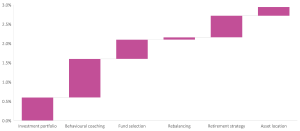
Source: Adapted from Vanguard Advisory Research Centre. (June 2025), ‘Putting a value on your value: Quantifying Vanguard Adviser’s Alpha in the UK’. All quantified values in this figure represent the midpoint of the figure ranges that are detailed in Vanguard’s paper, except for ‘Rebalancing’, which is stated specifically as 0.12%. The figure for ‘Investment portfolio’ assumes that a 60% stock portfolio exceeds broad market returns by 0.6%p.a. over the long run, which may not be an unreasonable assumption for long term expected outcomes of a systematic, risk factor tilted portfolio such as the ones implemented by Bloomsbury Wealth. Investment performance is not guaranteed. For illustrative purposes only.
It is highly likely, based on what the evidence tells us, that if an investor decided to do it alone and manage the portfolio themselves, they would end up with a less favourable outcome in the long run. New, better funds might be available that would be missed, the portfolio might need to be refined over time, all sorts of new investment fads and ideas might tempt them without the proper due diligence to understand what the risks and rewards are likely to be, and when markets crash, it is unlikely that they will have the fortitude to rebalance and may bail out altogether.
Making use of tax efficiencies is also an important administrative function that matters, which takes knowledge and discipline to execute. Failing to do so could be costly.
Investing is never easy, but a good planner will make it easier, and the chances of success are higher than doing it alone.
With investing, your capital is at risk. Opinions constitute our judgement as of this date and are subject to change without warning.
Important notice: This marketing communication is for information purposes only. Unless indicated, all views expressed in this document are those of the author(s). The information in this document does not constitute advice or a recommendation and you should not make any investment decisions on the basis of it.
Please note that this does not constitute tax advice and any comments or observations on taxation are merely to provide general guidance. You should therefore take appropriate tax advice from a qualified tax adviser as tax treatment depends on an investor’s individual circumstances and may be subject to change.
[1] Figure is an estimate and will vary based on individual circumstances.